
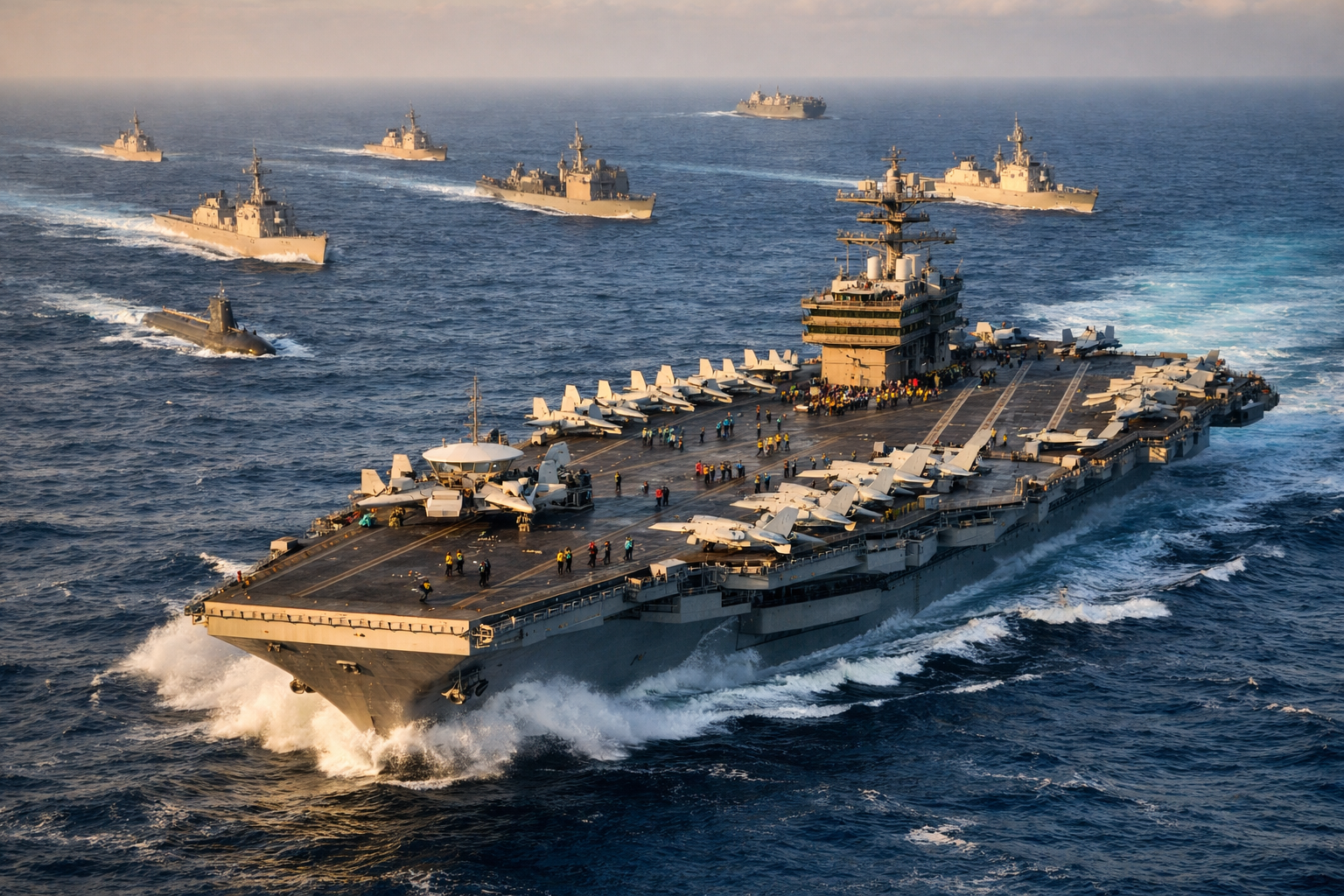
President Donald Trump says the United States is repositioning a “massive” naval force toward the Persian Gulf, arguing that Washington must be ready if Iran escalates violence at home or abroad. Speaking to reporters aboard Air Force One after engagements tied to the World Economic Forum, Trump said the U.S. is “watching Iran closely” and described the move as a contingency he hopes will never be used.
Multiple outlets report that the deployment includes the aircraft carrier USS Abraham Lincoln with destroyers and support ships shifting toward the region. Other U.S. naval activity, including separate exercises, has been cited as part of a broader posture meant to show depth and flexibility. Trump framed the movements as deterrence: a visible reminder that the U.S. can rapidly project airpower and missile defense into the Gulf if conditions deteriorate.
The immediate backdrop is Iran’s internal crisis. News reports and human-rights monitors describe a sweeping crackdown on nationwide protests, including large-scale arrests and allegations of planned executions for detainees. Iranian authorities dispute aspects of outside reporting and present lower fatality figures, but the overall picture has amplified international pressure. Trump has repeatedly linked the fleet move to the regime’s treatment of protestors, saying he wants Iranian leaders to understand the costs of further repression and escalation.
At the same time, the administration appears to be signaling economic leverage. Coverage of Trump’s remarks indicates he is considering tougher penalties on entities that keep trading with Tehran, alongside existing sanctions architecture. In his comments, Trump also claimed earlier threats helped dissuade Iranian officials from carrying out mass executions, though independent verification of that claim is limited in public reporting.
Regional dynamics complicate the message. Iran’s relationships with armed proxies, its history of maritime brinkmanship near key shipping lanes, and its long-running confrontation with Israel all raise the risk that a U.S. buildup could be interpreted as preparation for strikes rather than a warning. Analysts note that in congested waters, routine repositioning can be misread, which is why military-to-military deconfliction and consistent signaling matter as much as raw firepower.
Markets reacted to the headline risk. Some reporting linked the escalation narrative to higher oil prices, reflecting concern that any clash in or near the Gulf could threaten energy flows. For major importers, including India, a sustained spike can quickly pass through to inflation, logistics costs, and budget math, adding a global economic dimension to a crisis that begins as security signaling.
Iran has warned that an attack would trigger a wider confrontation, and recent coverage describes sharp exchanges between U.S. and Iranian officials. Trump, however, emphasized that he prefers to avoid war, portraying the fleet as insurance rather than an ultimatum. Allies in the region are bracing for spillover and retaliation.
What happens next will likely hinge on whether Tehran moderates its domestic response, whether proxy activity expands, and whether Washington pairs military posture with credible diplomatic off-ramps. For now, the U.S. is trying to project readiness while leaving room for negotiation, even as the risk of miscalculation rises.